Strategy shares fell 4.56% to $93.28 on July 31 after the company reported an $8.22 billion quarterly loss and prioritized restoring its STRC preferred stock to its $100 par value.
Summary
- Strategy stock closed at $93.28, approaching its lower Bollinger Band at $90.31.
- The company reported an $8.22 billion net loss after recording an $8.32 billion unrealized Bitcoin loss.
- Michael Saylor said Strategy would hold both cash and Bitcoin instead of directing all available capital toward BTC.
- Analysts at Benchmark and H.C. Wainwright maintained their buy ratings despite the sell-off.
Strategy stock slides after $8.22B quarterly loss
Strategy stock traded as low as $89.21 on Thursday before recovering to close at $93.28. The 4.56% decline took the Nasdaq-listed company below $90 during the session for the first time since July 1.
The decline followed Strategy’s second-quarter results, which included an $8.32 billion unrealized loss on its Bitcoin holdings. That pushed the company to a net loss of $8.22 billion, or $24.45 per share, during the quarter.
Strategy held 843,775 BTC at the end of the reporting period, representing a 25% increase from the start of the year. The company acquired the holdings for approximately $63.69 billion at an average price of $75,476 per coin.
Lower Bitcoin prices reduced the market value of the position to about $54.77 billion. Under fair-value accounting rules, changes in Bitcoin’s market price flow through Strategy’s reported earnings, exposing quarterly results to large swings.
Operating revenue offered one positive data point. Revenue increased 6.9% from $114.5 million in the comparable period last year to $122.4 million.
Why Strategy is prioritizing STRC over immediate BTC purchases
Executive Chairman Michael Saylor said during the earnings call that Strategy would move away from directing all available funds toward immediate Bitcoin purchases. The company instead plans to maintain a combination of cash and BTC.
“Perhaps the best way to buy the most Bitcoin is not to buy the most Bitcoin immediately,” Saylor said.
Chief Executive Phong Le said Strategy would refrain from buying additional Bitcoin while STRC traded below its $100 par value. The company’s variable-rate preferred stock ended July 31 at approximately $89.
Strategy repurchased about $25 million of STRC between July 20 and July 24 while raising $544 million through sales of its common stock. The transactions indicate that management views support for the preferred share as necessary to preserve its broader capital-raising model.
Restoring STRC to par could improve investor confidence in Strategy’s preferred securities and make future issuance more efficient. Those instruments have become part of the company’s strategy for raising capital without relying exclusively on common-share sales or conventional debt.
Strategy also held a $3.75 billion cash reserve, giving it room to cover dividend and interest obligations without selling Bitcoin during a market downturn.
MSTR chart points to weak momentum near $90
The daily chart shows Strategy stock trading near the lower end of its recent consolidation range. Thursday’s decline took the price below the Bollinger Band midpoint at $96.04 and toward the lower band at $90.31.
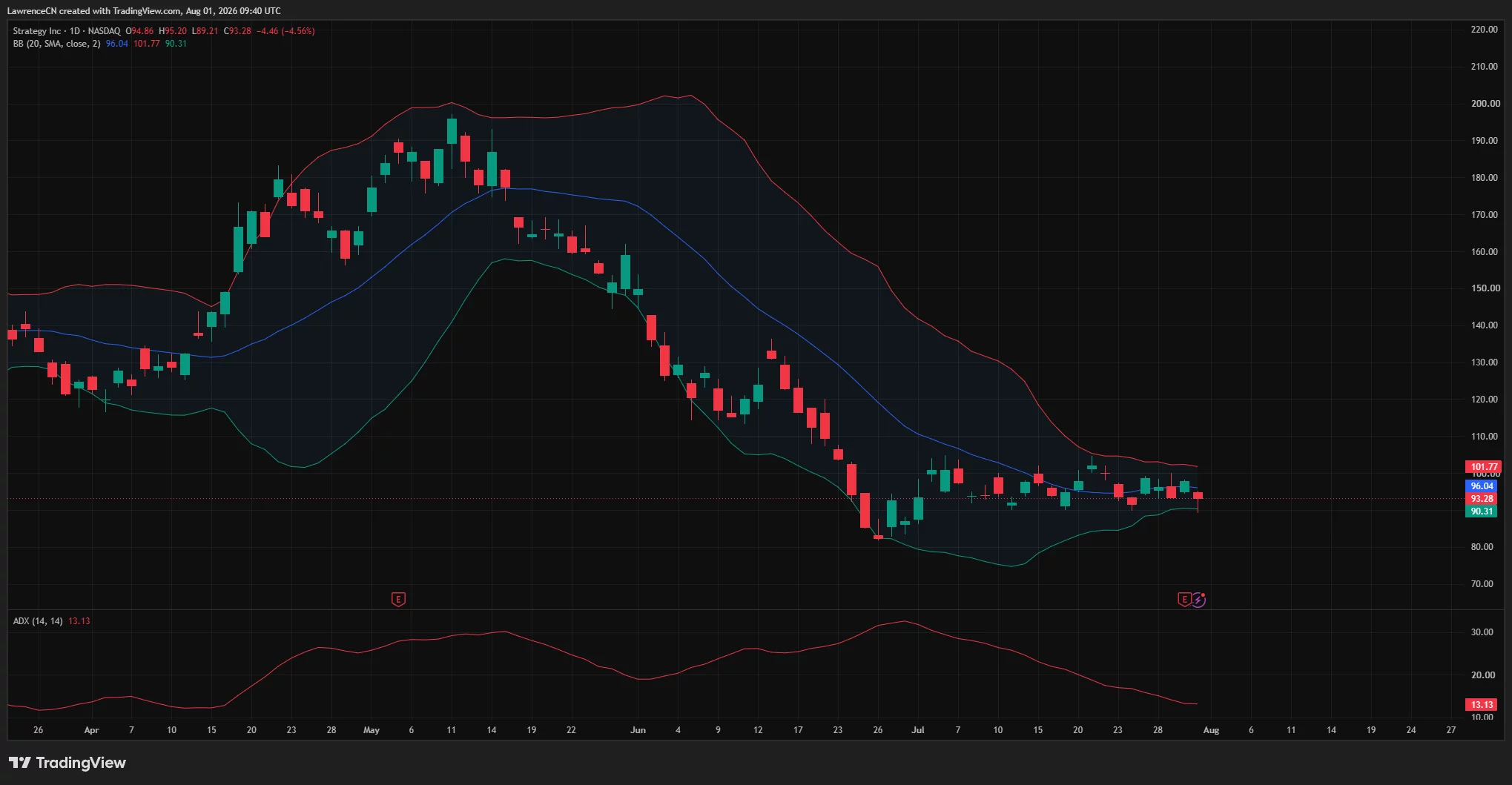
A daily close below $90.31 could confirm renewed selling pressure and expose the late-June low around $81 to $82. That area marked the bottom of the stock’s decline before its July stabilization.
The Average Directional Index stood at 13.13. An ADX reading below 20 generally indicates that the market lacks a strong directional trend, suggesting Strategy shares remain in consolidation despite the latest bearish session.
On the upside, MSTR would first need to recover above the $96.04 midpoint. A sustained move above that level could place the upper Bollinger Band at $101.77 within reach.
The narrow distance between the bands also shows that volatility has contracted following the stock’s steep decline from its May high near $200. A break outside the $90.31–$101.77 range could determine its next short-term direction.
Wall Street analysts retain bullish Strategy targets
Benchmark maintained its buy rating on Strategy but reduced its price target from $570 to $435. Analyst Mark Palmer said Saylor’s focus on bringing STRC back to par could strengthen the company’s ability to raise funds for future Bitcoin purchases.
H.C. Wainwright also maintained a buy rating and assigned Strategy stock a $325 target. The firm cited the company’s cash reserve and STRC repurchases as measures that could strengthen its balance sheet and limit the need to take on additional debt.
Both targets imply substantial upside from the July 31 closing price. However, their outlooks remain closely tied to Bitcoin’s performance and Strategy’s ability to issue securities on favorable terms.
For US investors, MSTR remains a publicly traded way to gain leveraged exposure to Bitcoin without holding the asset directly. That exposure also carries company-specific risks, including preferred-share obligations, equity dilution and earnings volatility caused by Bitcoin fair-value adjustments.
Bitcoin and STRC remain the next key catalysts
Strategy’s short-term stock performance will likely depend on whether STRC moves back toward $100 and whether Bitcoin recovers above the company’s average acquisition cost.
Management’s decision to preserve cash does not amount to abandoning its Bitcoin strategy. Instead, it delays immediate purchases while the company works to support the securities used to finance future acquisitions.
MSTR could remain range-bound while the ADX stays weak. A close below $90 would strengthen the downside case, while a recovery above $101.77 would signal that buyers are regaining control.
Disclosure: This article does not represent investment advice. The content and materials featured on this page are for educational purposes only.