Key Takeaways:
- Fairshake and Leading the Future have deployed over $100 million to influence the 2026 midterm election outcomes.
- A Politico poll found 45% of Americans view crypto as too risky, potentially hurting industry-backed candidates.
- Lobbyists for OpenAI and Ripple seek a federal framework by 2027 to preempt a patchwork of state-level AI laws.
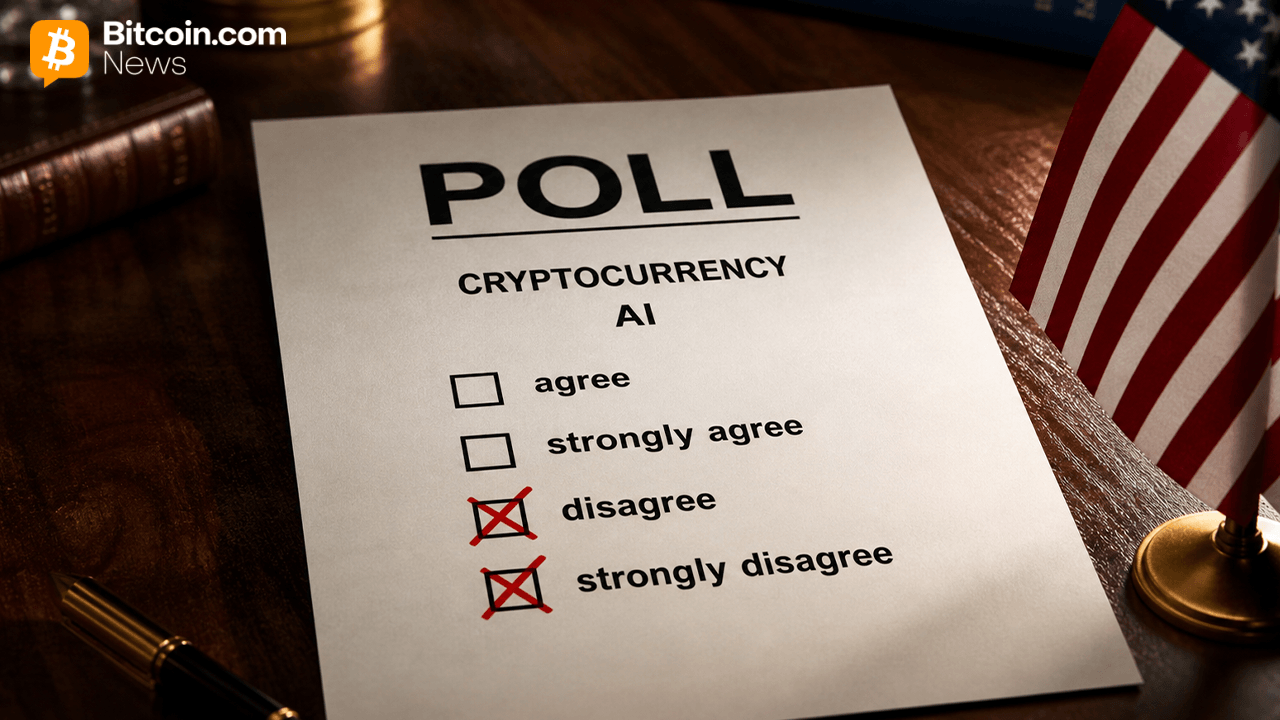
Politico Poll: 45% of Americans Say Cryptocurrency Risks Outweigh Potential Returns
New results from the Politico poll find broad public skepticism about crypto and AI, creating a possible conflict for candidates benefiting from an influx of contributions from these two sectors. These groups are pouring millions of dollars into competitive 2026 races to elevate politicians who they believe will support their agendas in Washington. Meanwhile, Americans have been slow to embrace either technology.
A 45% plurality of Americans say investing in cryptocurrency is not worth the risk, even if it can yield high returns. Additionally, a 44% plurality says AI is developing too quickly, according to the April survey conducted by the independent firm Public First. These findings highlight a growing disconnect between the capital being deployed by Silicon Valley and the sentiment of the average voter.
Nearly half of Americans say they trust a traditional bank with their money more than a cryptocurrency platform, while just 17% say the opposite. Furthermore, two-thirds of respondents support lawmakers either imposing strict regulations or setting broad principles for the AI industry. The results raise an emerging challenge for the industries as their aligned super PACs seek to translate financial might into political influence.
Politico’s reporting notes that several of these groups are already becoming the most dominant players on the political battlefield, spending heavily for candidates on both sides of the aisle. In some cases, these tech-focused entities are rivaling the fundraising of long-established party groups. It is too early to say how candidates associated with these groups will fare in November, but the two industries could draw different reactions from voters.
In hypothetical head-to-head matchups, Politico poll respondents were much less likely to choose candidates backed by a campaign group seeking looser regulations on artificial intelligence. Instead, voters favored candidates backed by groups advocating for more stringent rules on AI and tech companies. Skepticism of the industries suggests that heavy spending could eventually lead to voter backlash.
Leading the Future, a pro-AI super PAC founded in August, has already raised more than $75 million since its launch, according to recent filings with the Federal Election Commission. Through a network of PACs, it has deployed money on primaries in North Carolina, Texas, Illinois, and New York. Fairshake, a pro- crypto group primarily funded by Coinbase, Andreessen Horowitz, and Ripple Labs, has already spent $28 million across several competitive primaries.
Both industries are also spending big on Washington lobbyists to ensure their influence continues past Election Day. The AI lobby has ballooned in recent years, with OpenAI and Anthropic spending record amounts of money on lobbyists in the first quarter of 2026. The crypto industry has also poured millions into lobbying efforts to push Congress to enact a sweeping overhaul of digital asset regulation.
In the crypto industry, Politico’s study says that the super PAC spending is aimed at pushing through a market-structure bill called the CLARITY Act, which is pending in the Senate. Industry executives hope the proposed law would give the industry a stamp of legitimacy from Washington and deliver long-term certainty about how digital tokens will be overseen by market regulators.
The AI groups spending big in elections want to ensure their nascent industry is regulated by one set of federal rules rather than a state-by-state patchwork, according to Politico’s findings. While the tech sector leans toward the GOP’s deregulatory approach, some lobbyists are open to strong federal rules on AI in exchange for a ban on state laws. However, the polling suggests these efforts may run into broader public skepticism regarding job security and safety.
More than half of Americans say they have never and would not consider buying or trading cryptocurrency, the Politico poll notes. On artificial intelligence, nearly half of the respondents say it is likely to eliminate more jobs than it creates. Furthermore, a 43% plurality says the risks of the technology outweigh the benefits.
The skepticism cuts across partisan lines, with pluralities of voters for both Donald Trump and Kamala Harris in 2024 saying that investing in crypto is not a risk worth taking. A near majority of both groups — 49% of Harris voters and 46% of Trump voters — say AI is developing too quickly.
The Politico poll was conducted by Public First from April 11 to 14, surveying 2,035 U.S. adults online. Results were weighted by age, race, gender, geography, and educational attainment. The overall margin of sampling error is plus or minus 2.2 percentage points. Smaller subgroups have higher margins of error, Politico’s study noted. The Politico editorial regarding the industry poll was co-authored by Erin Doherty, Jasper Goodman, Jessica Piper, Daniel Barnes, and Brendan Bordelon.