Key Takeaways
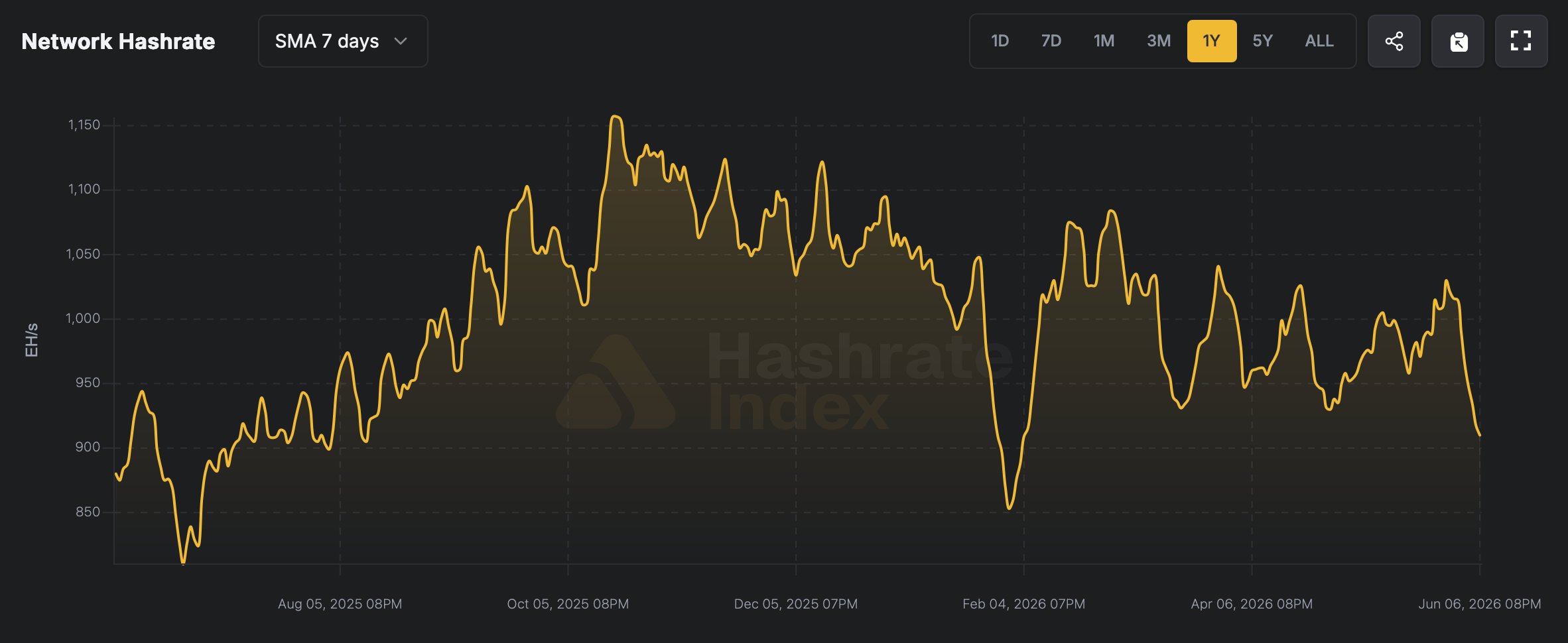
- Bitcoin’s network hashrate dropped 145 EH/s since May 28, falling to 885 EH/s as prices slide to February lows.
- Hashprice fell 26.96% in 30 days to $28.26/PH/s, with Elektron Energy CEO Rapha Zagury calling it Bitcoin’s first “ hashrate bear market.”
- A 10.76% difficulty reduction is projected for June 13, 2026, as fees below 1% of miner rewards remain a long-term structural concern.
Hashprice Falls 27% in 30 Days as Miner Revenue Tightens
Bitcoin’s computational strength has retreated notably since May 28, 2026, when the network was operating at 1,030 EH/s, according to data from hashrateindex.com. Today, that figure has fallen to 885 EH/s. The decline comes alongside shrinking miner revenue, which remains closely tied to bitcoin’s market value.
At press time, hashprice, the estimated daily return generated by 1 petahash per second (PH/s) of computing power, stands at $28.26 as of June 7. Thirty days ago, on May 7, that figure stood at $38.69, meaning mining revenue has fallen 26.96% from where it was a month earlier.
Onchain Fees Account for Less Than 1% of Miner Rewards as Block Times Drift Past 10 Minutes
Onchain fees remain negligible and account for less than 1% of miner rewards, representing just 0.73% of the total over the past day, according to the median average. One encouraging development is that the network’s difficulty has continued to decline in recent adjustments, recalibrating the effort required to discover new blocks. However, that also means less computational power is securing the network, and block intervals often drift beyond the protocol’s expected 10-minute average.
A sizable difficulty reduction is anticipated on June 13, 2026, after the previous adjustment raised difficulty by 1.72%. Although projections remain subject to change, the next epoch could bring a 10.76% decrease as slower block production persists. At present, average block times over the past day have hovered around 11 minutes and 12 seconds.
Elektron Energy CEO Declares Bitcoin’s First Historic Hashrate Bear Market
Many network observers contend that conditions have become increasingly challenging for mining participants, and Elektron Energy CEO Rapha Zagury has argued that Bitcoin is experiencing its first historic “ hashrate bear market.”
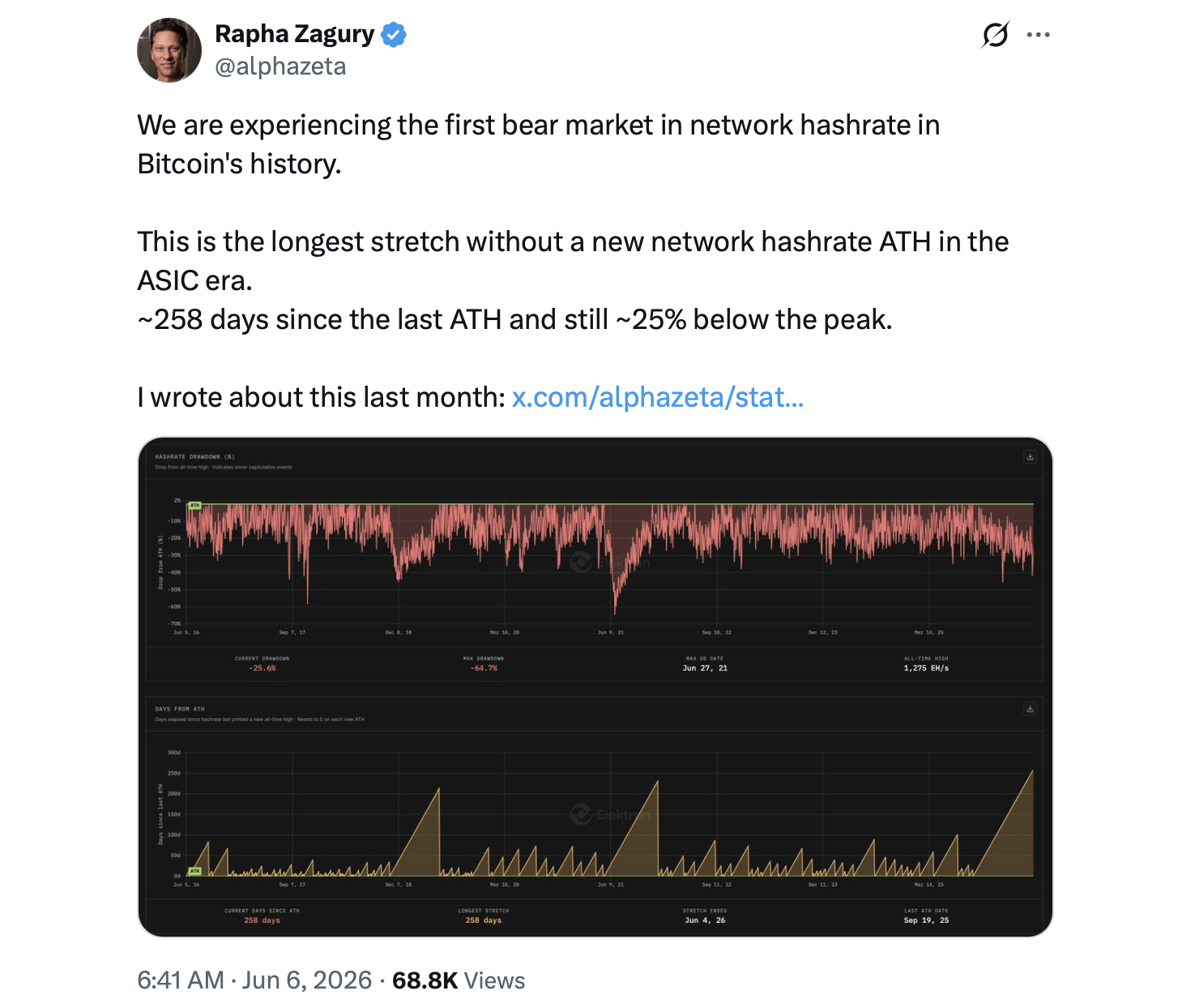
Zagury explained that this phenomenon is defined by a gradual, market-driven contraction that has pushed network hashrate roughly 25% below its September 2025 peak as unprofitable mining rigs continue to shut down, he wrote in an article on X last month. While this development challenges the industry’s long-standing assumption that hashrate only moves higher over time, Zagury maintains that Bitcoin’s security remains firmly intact because the capital required to execute a 51% attack remains prohibitively large.
Instead, Zagury argues that the more significant long-term challenge is a stagnant transaction fee market, which will eventually need to compensate for the steadily declining block subsidy. In the meantime, many publicly traded miners are redirecting resources toward artificial intelligence (AI) infrastructure, leaving leaner and more disciplined operators to capitalize on Bitcoin’s self-adjusting difficulty mechanism, which lowers competition and grants surviving participants a larger share of the network’s rewards.
Fee Market Stagnation Poses Deeper Long-Term Threat Than a Temporary Hashrate Decline
To many analysts, the fee market issue is gradual but deeply structural in nature. The block subsidy is cut in half every four years, yet transaction fees currently account for less than 1% of miner rewards. Before the 2024 halving, transaction fees represented a considerably larger share of miner revenue than they do today. Over time, that imbalance could carry far greater consequences than a temporary contraction in hashrate.