Key Takeaways:
- Paul Sztorc announced eCash, a new Bitcoin hard fork dropping in August 2026, with a 1:1 BTC coin split for holders.
- The fork activates BIP300/301 Drivechains, targeting 8 billion users across 7 Layer 2 chains in development.
- Sztorc plans to freeze the client 30 days before the fork and run bug bounty contests through summer 2025.
Sztorc Announces eCash Hard Fork Four Months Out, Sets 30-Day Code Freeze Before August Launch
Sztorc broke the news in a post on X, writing: “BREAKING: New Bitcoin Fork — I am helping create a new Bitcoin Hardfork — dropping this August, called ‘eCash.’” He confirmed the split will be 1:1, noting that a holder with 4.19 BTC will receive 4.19 eCash. Holders can sell, keep, or ignore the new coins entirely.
The project draws a direct line from Sztorc’s years of work on BIP300 and BIP301, the Drivechain proposals that have long divided the Bitcoin development community. On the eCash website at ecash.com, the project describes itself as a permanent fix to Bitcoin’s scalability and governance problems, not a stopgap measure.
The layer one (L1) node is described as a near-copy of Bitcoin Core, using SHA-256d mining. The chain will fork by resetting mining difficulty to its minimum value, which Sztorc acknowledged will cause chaotic conditions at launch. The development team plans to change seed nodes, the network name, and the network magic while continuing to merge changes from Bitcoin Core going forward.
BIP300 and BIP301 will activate through CUSF, the “core untouched soft fork” mechanism, meaning no lines of code on the L1 will be modified. The activation client will be published periodically and frozen 30 days before the scheduled fork date. Several bug bounty contests are planned for the summer ahead of launch.
The fork will replay all transactions at the time of the split, and the team will release a coin-splitter tool. Sztorc wrote that users are receiving four months of advance notice, contrasting this directly with the 2017 Bitcoin Cash hard fork where warnings were shorter and the process drew significant criticism.
Sztorc’s post listed seven layer two ( L2) chains currently in development, all merged-mined, so miners automatically earn additional revenue. Those chains include Truthcoin for prediction markets, Coinshift as a decentralized exchange ( DEX), Bitassets for NFTs and similar instruments, Bitnames for identity solutions, and Photon, which is designed to be quantum-resistant. A privacy-focused L2 modeled after Zcash is also included.
In an interview with Vlad Costea, Sztorc explained that the Drivechain model is specifically designed to prevent what he calls “dev capture,” the tendency for a single development team or set of financial backers to gain outsized control over a protocol’s direction. Competing L2 chains running under the same merged mining umbrella allow the market to decide which applications gain traction without any single group holding veto power.
The ecash.com website states the L2 infrastructure is already capable of onboarding 8 billion users at a planetary scale, a claim the team attributes to the merged mining architecture and the ability for independent developers to deploy their own Drivechain-based sidechains.
Sztorc drew a direct comparison to Bitcoin Cash ( BCH) in his announcement, emphasizing that eCash drops the word “ Bitcoin” from the name entirely. He argued that a clean brand separation, along with a longer advance notice window and a permanent technical fix, distinguishes this fork from prior attempts.
“Back in 2017, the BTC tech stack was strong, and expectations for Lightning were strong,” he wrote. “Today, it is the reverse.”
Community Opinion and Feedback
Naturally, the crypto community split along familiar lines when Paul Sztorc introduced his proposal to fork the network. One point of contention revolves around his chosen name, as “eCash” is already associated with an altcoin network that emerged from the Bitcoin Cash split via Bitcoin ABC. The eCash blockchain community, led by chief developer Amaury Séchet, has expressed clear dissatisfaction with Sztorc’s decision. Sztorc, however, responded to the criticism in a post on X and during a conversation with Joel Valenzuela.
On X, Sztorc argued, “The name ‘eCash’ is generic. I’m aware it has been used for several things, including: – Chaumian eCash , a predecessor idea to Bitcoin from the 80s/90s — later realized with his company DigiCash. – The ‘XEC’ Altcoin, which is currently ranked #164. – A private-but-custodial Bitcoin project, also called ‘cashu.’ We were able to get ecash.com — as well as several other related domains — so we are comfortable with the eCash name.”
Others took issue with Sztorc’s decision to fork Bitcoin itself. The software developer known as Calle contends that BIP300 drivechains, as proposed by Paul Sztorc, are fundamentally flawed, arguing they grant miners excessive authority and could enable a hashpower majority to misappropriate funds. In a post on X, Calle maintains the concept has been broadly dismissed by the Bitcoin community, yet its creator continues to push forward, criticize the Lightning Network, and repackage the idea in increasingly strained ways.
“The only solution left is to create a sh**coin for his sh***y idea,” Calle claimed.
Author and Bitcoin advocate, Steve Patterson, expressed optimism. “There are only a couple serious options for scaling Bitcoin: big blocks (as Satoshi intended), or real sidechains,” Patterson wrote on X. “So naturally, Core prevented both from being adopted. Big blockers forked off years ago, and now [Paul Sztorc] is finally forking off to implement sidechains.”
A Grok-powered sentiment scan of Sztorc’s post on X showed replies leaning sharply against the project. From roughly 50 to 60 top-level responses within a total of 347, about 80% to 85% were negative, Grok reported. Critics pointed to confusion with the existing eCash token, a fork of Bitcoin Cash, and objected to a proposed partial reallocation of Satoshi-era coins, which some framed as “stealing” dormant funds.
A smaller but vocal segment rejected the effort outright as a scam or developer self-interest. About 10% to 15% expressed support, citing the potential coin distribution for Bitcoin holders, interest in the Drivechain concept, or Sztorc’s measured tone. The rest raised technical questions or responded with sarcasm rather than engaging directly.
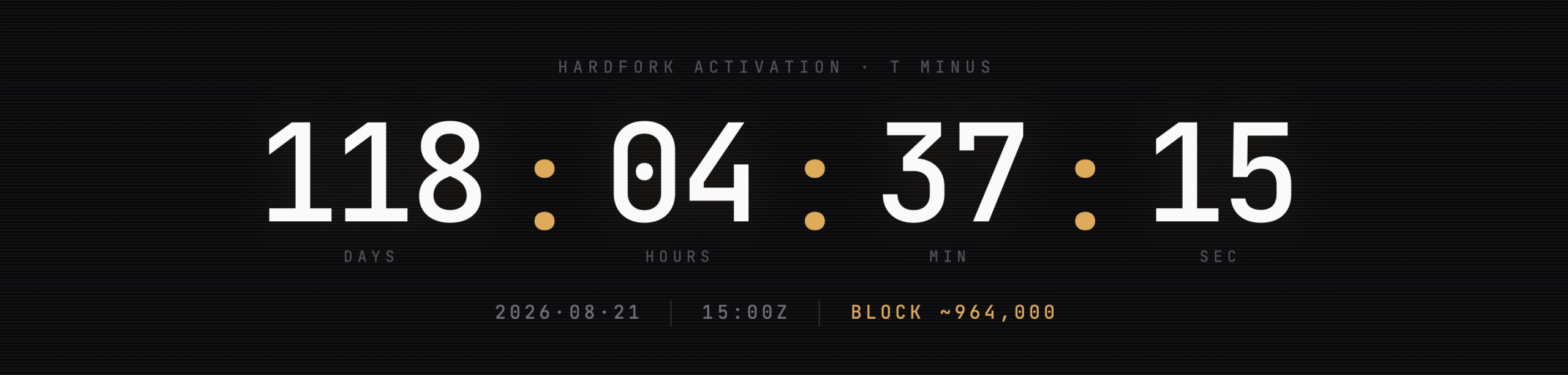
A Stress Test Is Coming in 118 Days
The announcement signals a coming stress test for the bitcoin mining community, since the difficulty reset at fork time will temporarily make eCash far easier to mine than Bitcoin. Miners capable of shifting hashrate quickly will likely accumulate a large share of early block rewards before difficulty adjusts.
Sztorc confirmed he will attend a Bitcoin conference in Las Vegas the week of the announcement, but said he would not discuss the fork onstage, calling it rude to make that kind of announcement in that setting.
The activation client link has been published for developers and node operators who want to begin testing ahead of the summer bug bounty program and the 30-day code freeze that will precede the August launch.