Key Takeaways
- Reversing its 2022 stance, Bradesco will next launch a crypto custody service to boost adoption.
- To legitimize the market, Renata Petrovic said the 5,300-branch bank will next offer full crypto custody.
- As part of two internal pilots, Bradesco tested stablecoins to improve foreign trade markets.
Bradesco Announces Future Launch of Cryptocurrency Custody Services
Traditional financial institutions are rushing to provide digital asset-based financial services, seeking to keep up with new technologies and retain their customers.
Bradesco, the second-largest bank in Brazil with over 5,300 branches, announced last week that it will enter the cryptocurrency custody business, enlisting an undisclosed partner.
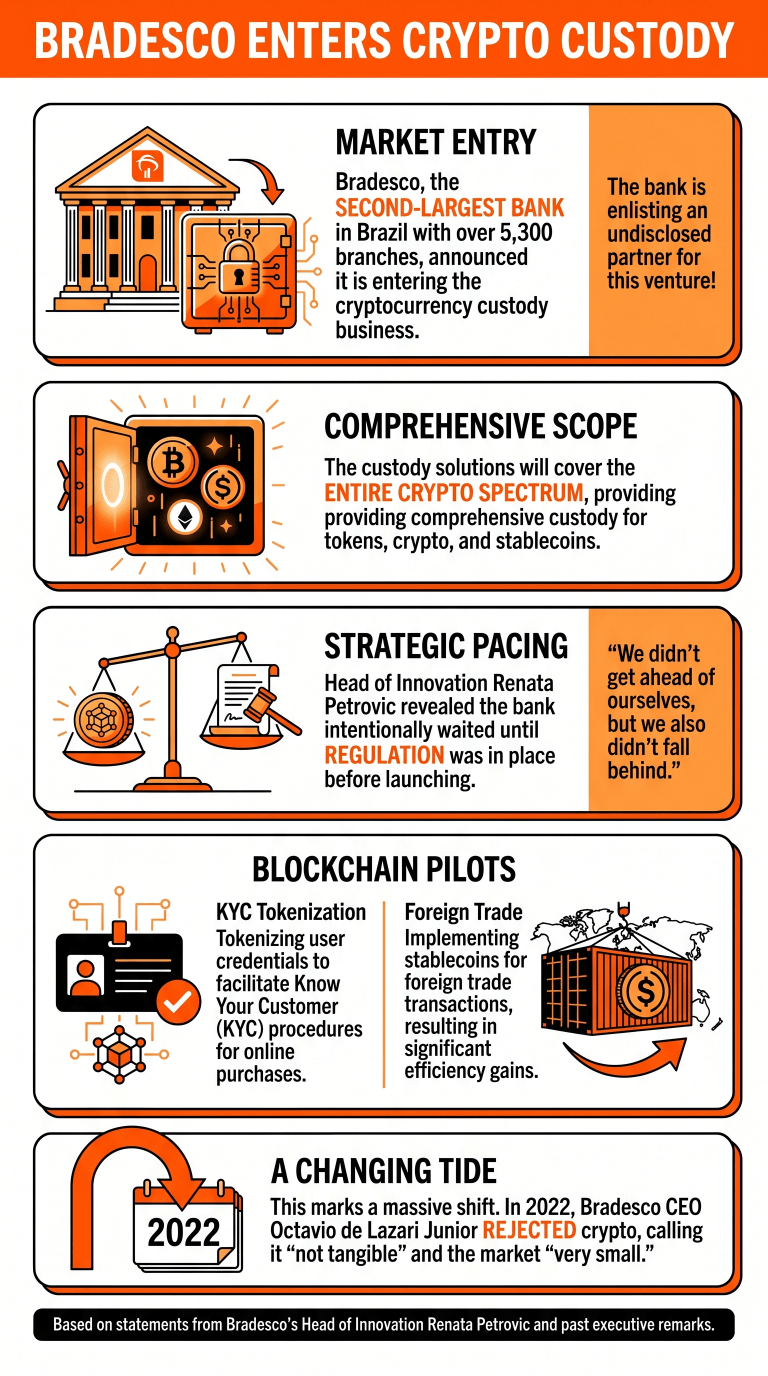
Renata Petrovic, head of innovation at the bank, revealed that the bank had internally created a structure focused on digital assets and that these custody solutions would be provided for the entire cryptocurrency spectrum.
“We are preparing to have a digital asset custody business; we already have a partner who will work with us, providing comprehensive custody for all assets, including tokens, crypto, and stablecoins,” Petrovic stated.
Explaining the slow pace of adoption of these new technologies at Bradesco, Petrovic stated that the bank had waited until the regulation was in place before entering the crypto business. “We didn’t get ahead of ourselves, but we also didn’t fall behind. We’ve been preparing for this moment of entering the market for a long time,” she stressed.
While Bradesco had not publicly revealed its crypto initiatives, it had been running two pilots implementing blockchain solutions, including a know-your-customer (KYC) project that tokenizes user credentials to facilitate KYC procedures for online purchases. Another initiative implemented the use of stablecoins for foreign trade transactions, resulting in efficiency gains.
Bradesco’s announcement comes after the bank previously rejected interest in crypto in 2022. At that time, Bradesco CEO Octavio de Lazari Junior stated that cryptocurrencies were “investments that are not tangible and are riskier, with people knowing about the risk they are taking and may want,” assessing that the digital assets market was “very small.” Nonetheless, it participated in the pilot phase of drex, Brazil’s central bank digital currency ( CBDC).