Key Takeaways:
- On May 2, China’s MOFCOM invoked the Blocking Statute against U.S. OFAC sanctions on 5 local oil refiners.
- SMU’s Henry Gao notes this 1st use of the statute since 2021 forces global companies to pick between markets.
- Next, Chinese firms can sue for losses from these sanctions, as Beijing might prepare countermeasures.
China’s Government Invokes Blocking Statute On Five Local Oil Refiners
China has moved to defend its commercial interests in the current trade battle it is waging against the U.S., and the extent of its sanctions against Chinese entities.
On May 2, the Chinese Ministry of Commerce (MOFCOM) issued a resolution invoking a series of documents collectively referred to as the Blocking Statute to counter the unilateral sanctions imposed by the U.S. government on five local oil refiners.
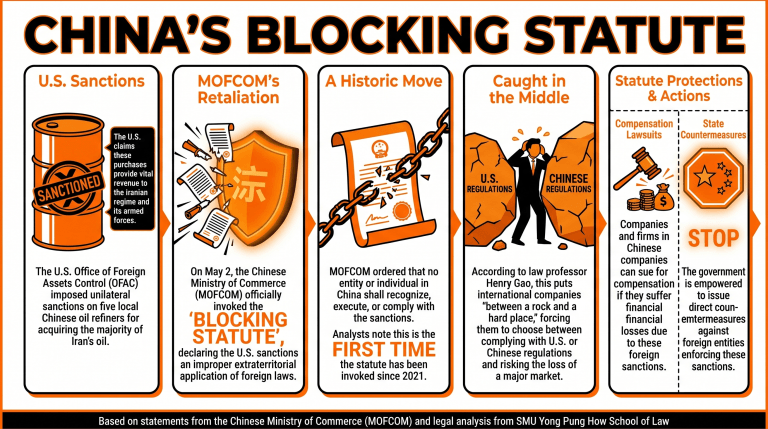
According to the Office of Foreign Assets Control (OFAC), Hengli Petrochemical (Dalian) Refining & Chemical, Shandong Shouguang Luqing Petrochemical, Shandong Jincheng Petrochemical Group, Hebei Xinhai Chemical Group, and Shandong Shengxing Chemical provide “a vital source of revenue to the Iranian regime and its armed forces” by acquiring the majority of Iran’s oil.
Nonetheless, after conducting an assessment, MOFCOM determined that these sanctions constitute “an improper extraterritorial application of foreign laws and measures.”
The institution called to ignore these designations “to safeguard national sovereignty, security, and development interests, and to protect the legitimate rights and interests of Chinese citizens.”
MOFCOM stated that “no entity or individual shall recognize, execute, or comply with the sanctions measures.” According to analysts, this is the first time that such a statute has been invoked since 20201, when it was first issued.
The application of these measures might put companies operating in both countries “between a rock and a hard place,” according to Henry Gao, Professor at SMU Yong Pung How School of Law, as they will have to comply with U.S. or Chinese regulations and lose one of these large markets.
Under this statute, companies and firms in China can sue for compensation if they have suffered losses due to these sanctions. Similarly, the Chinese government can also issue countermeasures against these foreign sanctions.