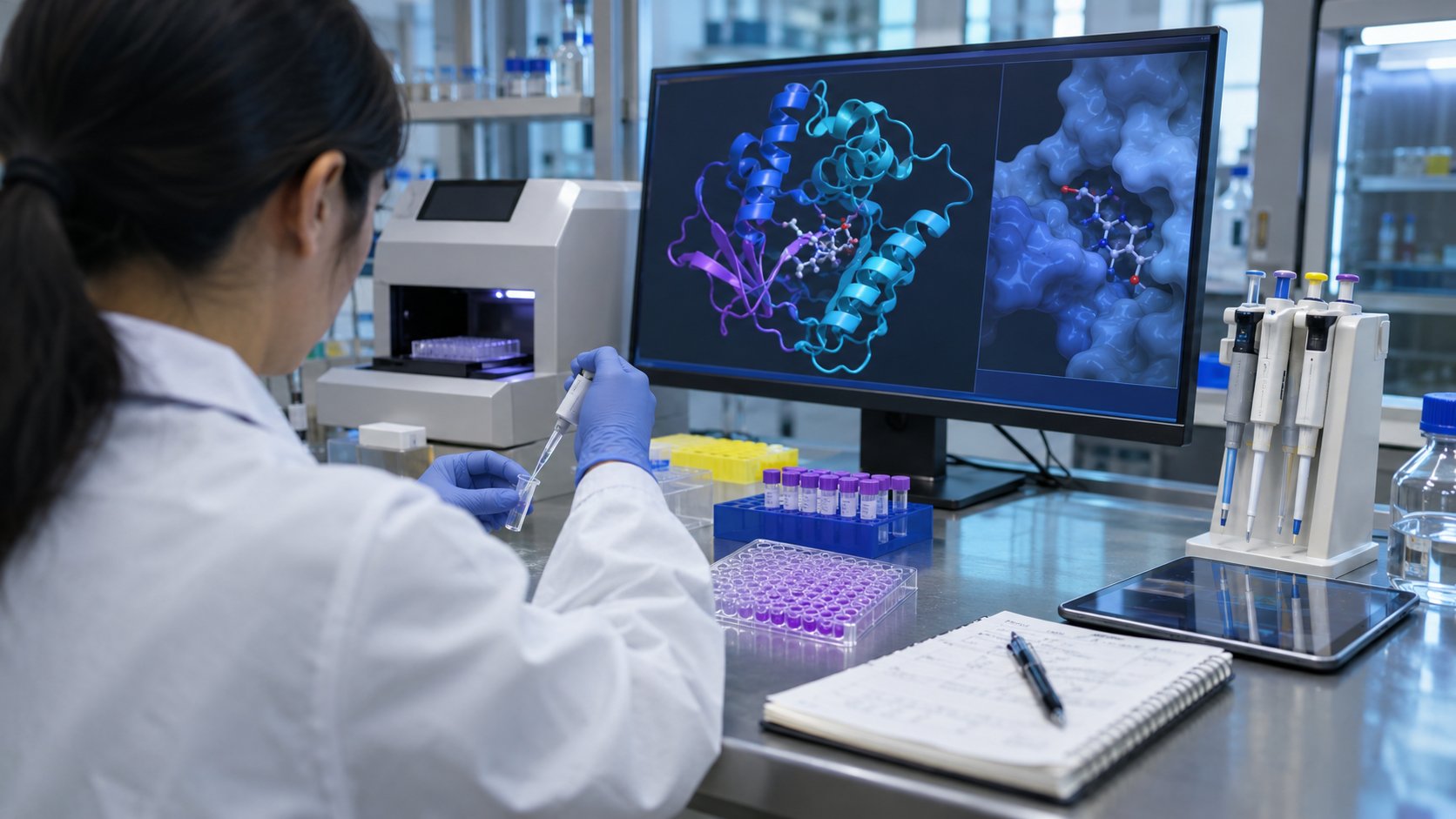
OpenAI’s GPT-6.2 managed to design proteins that attached to five different biological targets in lab tests. That’s a promising result, but there’s a catch: Of the 322 AI-designed minibinders selected for testing, only 35 successfully bound their intended targets.
The findings, announced Nov. 24 following experiments with research partner Onava, suggest that a general-purpose AI model can contribute to protein design. But for biotech teams hoping to speed up drug discovery, a 10.9% binding rate is only a starting point. A protein that attaches to its target isn’t necessarily safe, effective, or suitable for use in a drug.
OpenAI tested GPT-6.2 on several tasks, from designing new protein structures to modifying existing proteins. The success rates varied considerably, and the work still required specialized AI tools. Those differences are important for researchers deciding whether the technology belongs in their workflows.
What the GPT-6.2 protein-design experiments showed
In its research announcement, OpenAI said GPT-6.2 generated new three-dimensional protein structures using reasoning and code, without relying on specialized biology models to create the initial designs.
Researchers tested the resulting proteins against five biological targets associated with cancer and immune disorders. Here’s how many successfully bound:
- PD-L1: 5 successful binders.
- IL-7Rα: 3 successful binders.
- TrkA: 1 successful binder.
- VEGF-A: 8 successful binders.
- IL-17A: 18 successful binders.
Together, that’s 35 hits from 322 tested designs, or 10.9%. More than half of the successful binders targeted IL-17A, while just one worked against TrkA.
There’s an important detail behind that percentage. The 322 proteins had already been selected for testing with help from specialized AI tools. The 10.9% figure therefore describes the lab-tested candidates, not every design GPT-6.2 initially produced.
The model performed better when it worked with existing protein structures.
In one set of sequence-redesign experiments, 75 of 88 designs targeting MDM2 showed binding (85%). The results fell to 26 of 42 for VEGF-A (62%) and just 8 of 59 for PD-1 (14%).
Another experiment, which generated new sequences for previously unpublished protein structures, produced 14 successful binders from 107 designs, or 13.1%.
Antibody redesign delivered stronger results. Of 182 designs targeting IL-4Rα, 128 showed binding (70%). Another 179 of 272 redesigned antibody fragments (66%) retained binding to their original PD-1 or PD-L1 targets.
These aren’t interchangeable tests. Improving a protein that already works is a different challenge from creating one from scratch. A biotech team comparing AI tools would need to test them on the same task before deciding which performs better.
The redesigned minibinders also differed substantially from their originals. Median sequence differences reached 50% for VEGF-A, 43% for MDM2, and 15% for PD-1.
That suggests GPT-6.2 made substantial changes rather than simply copying existing sequences. It doesn’t establish whether those changes improved binding strength or selectivity.
GPT-6.2 also had help. After the model generated three-dimensional protein structures, researchers used a specialized tool called SolubleMPNN to produce corresponding amino acid sequences. Other models helped select candidates for lab testing.
OpenAI acknowledges that the experiments don’t demonstrate protein design from start to finish without specialized tools.
For teams exploring AI-driven protein research, that distinction affects how much work the technology might actually save. If a general-purpose model still needs several specialist systems and lab screening to deliver usable candidates, those steps belong in any cost or performance comparison.
OpenAI also reported results from a separate molecular-docking evaluation. GPT-6.2 correctly predicted experimentally observed molecular positions and orientations in 93% of scored cases, compared with 50% for the specialized DiffDock-L model.
Those numbers sound impressive, but docking accuracy isn’t the same as protein-binding success. A model that predicts how molecules fit together still needs laboratory experiments to establish what actually happens.
What GPT-6.2 protein binding results still need to prove
Getting a protein to attach to its target is one step toward drug discovery. The harder questions come afterward.
How tightly does it bind? Does it also attach to proteins it shouldn’t? Does it remain stable under useful conditions? And can researchers manufacture it reliably?
OpenAI reports measuring binding strength, but its public announcement doesn’t provide a comprehensive assessment of affinity, selectivity, stability, toxicity, or manufacturability for the tested designs.
Joy Jiao, who leads life-sciences research at OpenAI, described the findings as a proof of principle in Nature’s report. The research has an accompanying technical preprint, but hasn’t undergone peer review or independent laboratory replication.
For biotech teams considering GPT-6.2, a small, controlled pilot would be more useful than relying on the reported hit rates alone.
Here’s what that evaluation should cover:
- Compare the same tasks. Run GPT-6.2 and specialist tools such as RFdiffusion against the same biological targets. Don’t compare results from redesigning known proteins with results from creating entirely new ones.
- Check binding quality. Measure how tightly each protein binds, whether it attaches to unrelated targets, and whether it produces the intended biological effect.
- Repeat successful tests. Prepare fresh protein samples and run independent assays. A positive result in one screening experiment doesn’t guarantee the same result next time.
- Count the full cost. Track how many designs were generated, filtered, synthesized, and tested. Include the additional software, computing resources, laboratory work, and time needed to reach a confirmed result.
Consider a team testing 100 AI-designed proteins. Ten show initial binding, but several attach to the wrong targets, others bind too weakly, and a few fail when the experiment is repeated.
That team doesn’t have ten promising drug candidates. It has a smaller set of proteins that may deserve further investigation, along with the time and expense of figuring out which ones are useful.
This gap between AI-generated possibilities and verified scientific results has appeared in earlier AI research, where models helped generate hypotheses about brain-cell behavior. The ideas still needed laboratory testing before researchers could draw firm conclusions.
Teams also need to keep track of where their designs come from. Researchers have explored watermarking AI-designed proteins, although that doesn’t mean GPT-6.2’s designs include watermarks.
For day-to-day research, keeping records of model versions, generated sequences, filtering decisions, and lab results gives scientists a clearer way to reproduce experiments and investigate unexpected findings.
There are safety considerations, too. OpenAI’s GPT-6.2 safety assessment places the ChatGPT version released Nov. 23 at its internal High threshold for biological and chemical capabilities.
Research organizations considering the model should check who can access it, what data it can use, and whether existing safeguards cover connections to laboratory tools and sensitive biological information.
OpenAI and Onava have demonstrated that GPT-6.2 can produce proteins that bind to real biological targets. The next test is whether independent researchers can reproduce those results and determine which designs remain useful after more demanding experiments.
For now, GPT-6.2 looks promising as another tool for early protein research. Whether it can actually shorten the path to a viable drug remains unproven.
Also read: Isomorphic Labs’ $5 billion funding round will support its effort to move AI-designed drug candidates toward human trials.