Index provider MSCI said on Wednesday, November 11, that it will remove Strategy (MSTR) from its global stock indexes. Strategy is the largest corporate holder of Bitcoin, and the change takes effect after the market close on November 30. Funds that track those indexes will have to sell their shares.
MSCI to Remove Strategy and Metaplanet From Indexes, Potential MSTR Outflows Could Reach $8.8B
According to Reuters, MSCI will remove Strategy (MSTR), Japan's Bitcoin treasury firm Metaplanet, and UK-based uranium investment company Yellow Cake from its global indexes, effective… pic.twitter.com/QwBEot3XUt
— Wu Blockchain (@WuBlockchain) November 11, 2026
The MSTR MSCI index decision hit the stock first. MSTR closed Wednesday at $122.35. On Hyperliquid, where a contract tracking the stock trades around the clock, it is at $117.09 on Thursday morning, down 4.3% and at its lowest since August 23.
Bitcoin barely moved. It trades at $73,540 on Binance, down 0.4% in 24 hours. Japan’s Metaplanet, which is also being removed, is down 3.4% since Tuesday.
So why did MSCI drop Strategy, how much selling could follow, and what does it mean for Bitcoin?
MSTR MSCI Index Exit: Why MSCI Dropped Strategy
MSCI decided that Strategy looks more like a fund holding Bitcoin than a company running a business. Strategy still sells software, but nearly all of its value comes from its 850,364 BTC, about 4% of all Bitcoin that will ever exist.
The decision is the first under a new MSCI rule for “non-operating companies”. The rule first checks whether a company has substantial operating assets. Companies that fail face five financial tests, and failing four of them can make a company ineligible.
The fight has run for more than a year:
- October 10, 2025: MSCI proposes excluding companies whose crypto holdings make up 50% or more of their assets.
- January 6, 2026: MSCI drops that plan but says it will review all non-operating companies.
- August 3, 2026: MSCI opens a consultation on the new rule.
- Mid-October 2026: MSCI finalizes the rule for the November review.
- November 11, 2026: Strategy is marked “deleted”.
Strategy is not alone. Japan’s Metaplanet and Upexi are also being removed, and Ether treasury company SharpLink is on a watch list. The rule is not only about crypto: uranium investment company Yellow Cake is being deleted too.
Strategy has fought the rule from the start. In its response to MSCI, it argued that “operating” and “non-operating” have no definition under standard accounting rules. After the decision, it called the rule “discriminatory, arbitrary and misguided” and asked MSCI to withdraw it.
DISCOVER: Best New Cryptocurrencies to Invest in 2026
The forced selling from the MSTR MSCI index exit has a date: the November 30 close, when index funds rebalance. JPMorgan estimated about $2.8 billion of selling from funds that track MSCI, and up to $8.8 billion if other index providers follow.
Strategy says the impact is smaller. It says MSCI-linked funds hold about 13 million shares, 3.1% of its stock, which is less than one day’s trading volume.
The bigger risk is slower Bitcoin buying. Strategy pays for most of its Bitcoin by selling new shares and preferred stock. Each MSTR share is backed by $137.21 of Bitcoin, but the stock closed at $122.35, 11% below that. On Hyperliquid this morning, the gap is 15%.
When a stock trades below the value of the Bitcoin behind it, selling new shares to buy more Bitcoin leaves existing holders with less Bitcoin per share. Fewer index investors could keep that gap open.
DISCOVER: Bitcoin ETF Paradox: NVDA Stock Has a CEO Premium That Bitcoin Never Needed
MSTR Has Fallen Further Than Bitcoin Since the First Proposal
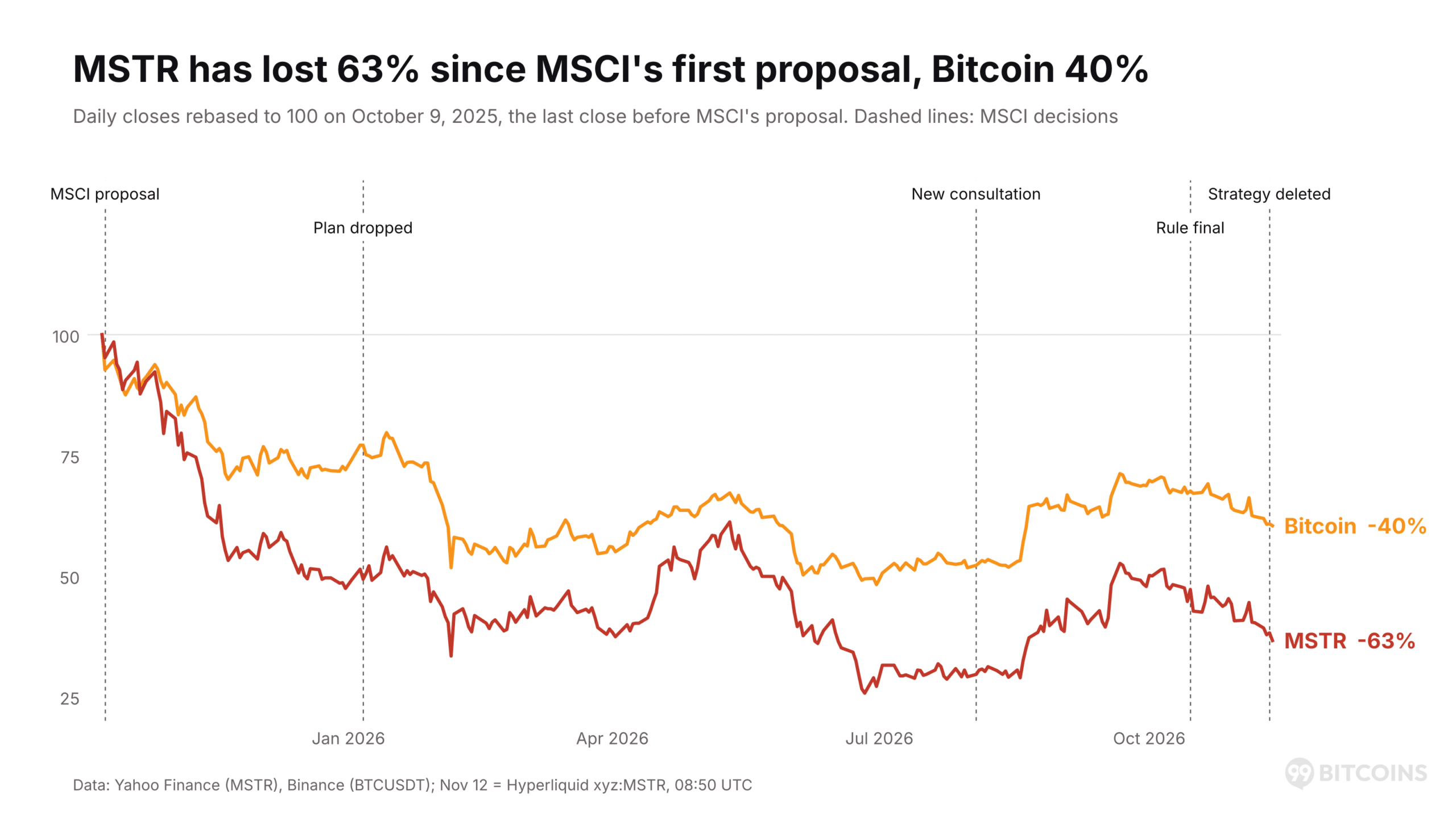
We tracked MSTR and Bitcoin from October 9, 2025, the last close before MSCI’s first proposal. Since then, MSTR has fallen 63% and Bitcoin 40%.

Past MSTR MSCI index news has mostly brought bad days. We measured both from the close before each of the five MSCI announcements to the close after it. MSTR fell after four of the five, by 4.5% after the rule was finalized and 4.3% so far after the deletion. Bitcoin also fell after four of the five. It fell harder than MSTR the first two times, in October 2025 and January 2026, but much less after the last two.
Even good news did not help. When MSCI dropped its first plan in January, MSTR still fell 1.8% over the next two days. The stock has been trading on Bitcoin’s direction, not on the index news alone.
MSTR Price Analysis: Can It Hold $116?
On Hyperliquid’s daily chart, where each candle covers one day, MSTR sits below both of its exponential moving averages (EMAs), averages that give recent prices more weight. The 50-day EMA stands at $136.98 and the 200-day EMA at $134.61, both about 15% above the price.
- Resistance: $124.13, Wednesday’s high, then $146.06, the November 4 high.
- Support: $116.47, Thursday’s low, then $107.35, the June 22 low. Below that, $89.33, the July 31 low.

MSTR 1D chart. Source: Hyperliquid.
| Path | What has to happen | Next stop |
|---|---|---|
| Push higher | MSTR closes above $124.13 | $146.06, the November 4 high |
| Stall | MSTR holds between $116.47 and $124.13 into November 30 | A range until index funds finish selling |
| Slip | MSTR closes below $116.47 | $107.35, then $89.33 |
The MSTR MSCI index exit is now a known date. If Bitcoin holds above $72,727, Tuesday’s low, the November 30 selling may already be in the price. If it breaks lower, MSTR tends to fall harder.
DISCOVER: 9+ Best High-Risk, High-Reward Crypto to Buy in 2026
Follow 99Bitcoins on X For the Latest Market Updates, and Subscribe on YouTube For Daily Expert Market Analysis.
The post MSCI Drops Michael Saylor’s Strategy (MSTR): Is Bitcoin Price at Risk? appeared first on 99Bitcoins.