Bitcoin price has recovered above $76,000 on Friday, November 6, after a selloff in US technology stocks and $430.2 million in spot Bitcoin ETF withdrawals pushed the cryptocurrency below that level during Thursday’s trading session.
Summary
- Bitcoin price recovered above $76,000 after technology stocks plunged and leveraged cryptocurrency liquidations exceeded $1 billion.
- US spot Bitcoin ETFs lost $430.2 million Thursday, with Fidelity and BlackRock leading fund withdrawals.
- CryptoQuant reported spot selling exceeded buying on Binance and Coinbase as Bitcoin demand remained weak.
- Bitcoin price faces resistance near $77,900, while losing $75,300 could expose further declines toward $72,000 next.
According to crypto.news price data, Bitcoin (BTC) traded near $76,098 following its latest rebound, although it remained more than 5% lower over the previous 24 hours. The recovery followed a difficult session for financial markets, with technology stocks suffering heavy losses and leveraged cryptocurrency traders facing more than $1 billion in liquidations.
Meanwhile, the rebound has brought attention back to the $75,000 support level, which traders have been watching since Bitcoin lost momentum following its brief recovery above $80,000 after the US midterm elections.
Bitcoin price rebounds as ETF outflows reach $430 million
Bitcoin’s return above $76,000 followed another session of withdrawals from US-listed spot Bitcoin exchange-traded funds, reversing the modest buying activity recorded on Wednesday.
According to Farside Investors data, the funds recorded $430.2 million in net outflows on November 5, compared with $74.6 million in inflows the previous day. The withdrawals brought total net outflows for the first four November trading sessions to approximately $869.8 million.
Fidelity’s Wise Origin Bitcoin Fund (FBTC) led the latest withdrawals with $199.9 million, reversing its $236.7 million inflow on Wednesday. BlackRock’s iShares Bitcoin Trust (IBIT) followed with $105 million in outflows, bringing its withdrawals since October 30 above $1 billion.
As crypto.news previously reported, Fidelity accounted for much of the change in daily ETF flows, while BlackRock continued recording withdrawals despite their smaller size compared with Wednesday.
The selling was not limited to the two largest funds. Grayscale’s GBTC lost $49.9 million, Franklin Templeton’s EZBC recorded $32.9 million in outflows, and VanEck’s HODL shed another $23.6 million.
Thursday’s withdrawals followed a difficult session on Wall Street, where the Nasdaq Composite fell 5.5% and the S&P 500 declined 4.3%. Investors were concerned that the Democratic Party’s victories in the midterm elections could affect policies supporting artificial intelligence infrastructure spending.
Meanwhile, cryptocurrency liquidations reached approximately $1.26 billion over 24 hours, according to CoinGlass data. Long positions accounted for roughly $1.12 billion as falling prices forced leveraged traders to close their positions.
The market selloff on Thursday had already pushed Bitcoin below $76,000, wiping out the recovery that briefly carried the cryptocurrency above $80,000 following the election results.
Bitcoin selling pressure grows on Binance and Coinbase
Alongside ETF withdrawals, exchange trading data has pointed to weakening demand from investors buying Bitcoin directly.
In a November 6 CryptoQuant analysis, analyst Darkfost reported that selling volume had overtaken buying volume on Binance and Coinbase, two of the largest cryptocurrency exchanges.
At the end of August, the 30-day average spot net volume delta stood at positive $64.8 million on Binance and $64.3 million on Coinbase. The figures showed that buying activity exceeded selling during a period when Bitcoin climbed from $63,000 toward $85,000.
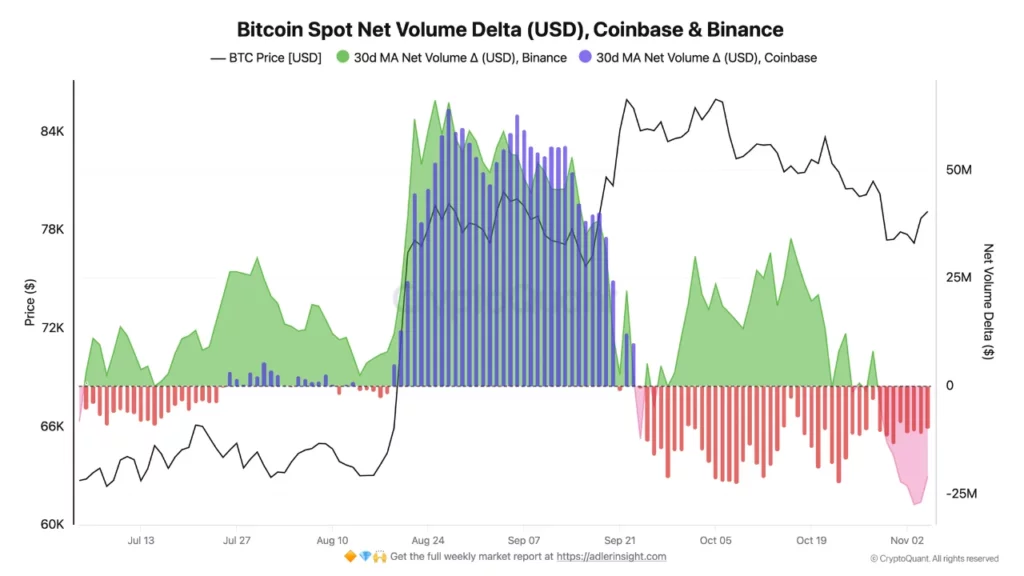
By November 5, however, those readings had fallen to negative $28 million on Binance and negative $9.4 million on Coinbase. Darkfost said the deterioration began in October on Coinbase, while Binance maintained positive readings for longer.
Another market observer, Rain, pointed to CryptoQuant’s 30-day apparent demand indicator, which has remained negative for much of the period since late August. Its latest reading stood near negative 160,000 BTC, even though Bitcoin had previously recovered above $85,000 in September.
The analyst questioned the strength of that recovery because demand continued weakening while prices remained relatively elevated. A temporary improvement in early October failed to hold, leaving the 30-day average under pressure again.
Evan Ceolini, CEO of cryptocurrency exchange aggregator SwapSpace, told crypto.news that Bitcoin’s predictable issuance schedule is an important part of its value, although scarcity alone cannot guarantee price gains.
“A reduction in the rate of new BTC issuance alone doesn’t guarantee an increase in Bitcoin’s value: much depends on demand and other market factors,” Ceolini said.
Bitcoin price prediction: Can BTC recover toward $80,000?
Despite Friday’s recovery, Bitcoin continues trading below its nine-day exponential moving average at $77,909.73, indicating that sellers retain control of the short-term trend.
The Money Flow Index stands at 27.74, below the 30 level commonly associated with oversold conditions. Although such readings sometimes precede a rebound, the indicator currently shows limited buying strength.
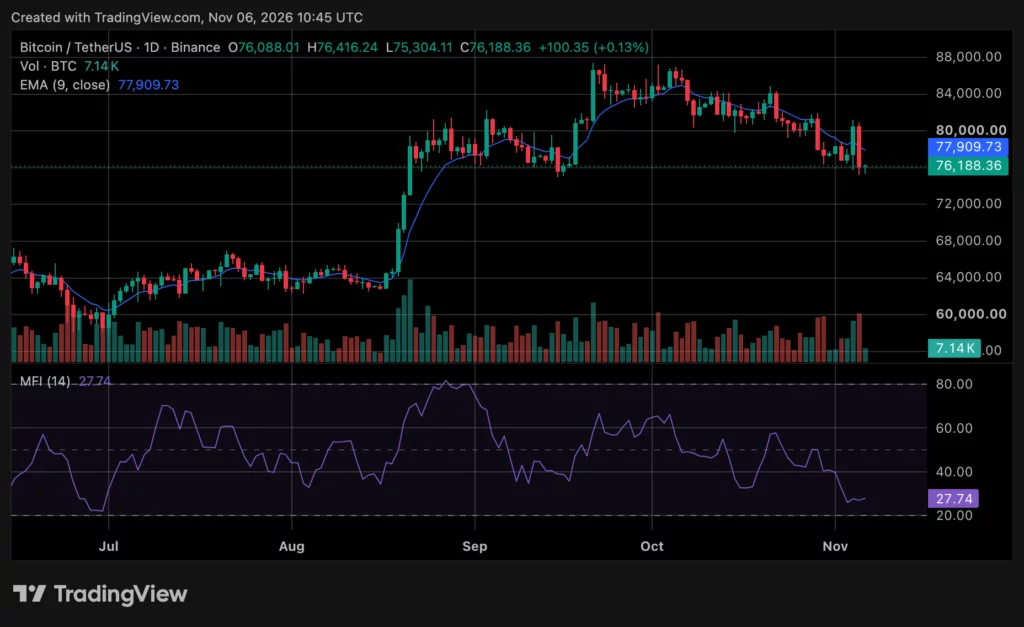
Immediate support lies around $75,300, with another important level near $72,000. A sustained move above $77,900 could improve the technical outlook and allow BTC to challenge $80,000 again.
Crypto analyst Michaël van de Poppe has suggested that Bitcoin could establish a bottom after another move toward $75,000, particularly if technology stocks stabilize following Thursday’s losses.
Darkfost identified $70,000 as another possible downside target if Bitcoin loses $75,000. According to his analysis, that level contains a substantial concentration of investor cost bases, making it an area where buyers could attempt to defend their positions.
Disclosure: This article does not represent investment advice. The content and materials featured on this page are for educational purposes only.