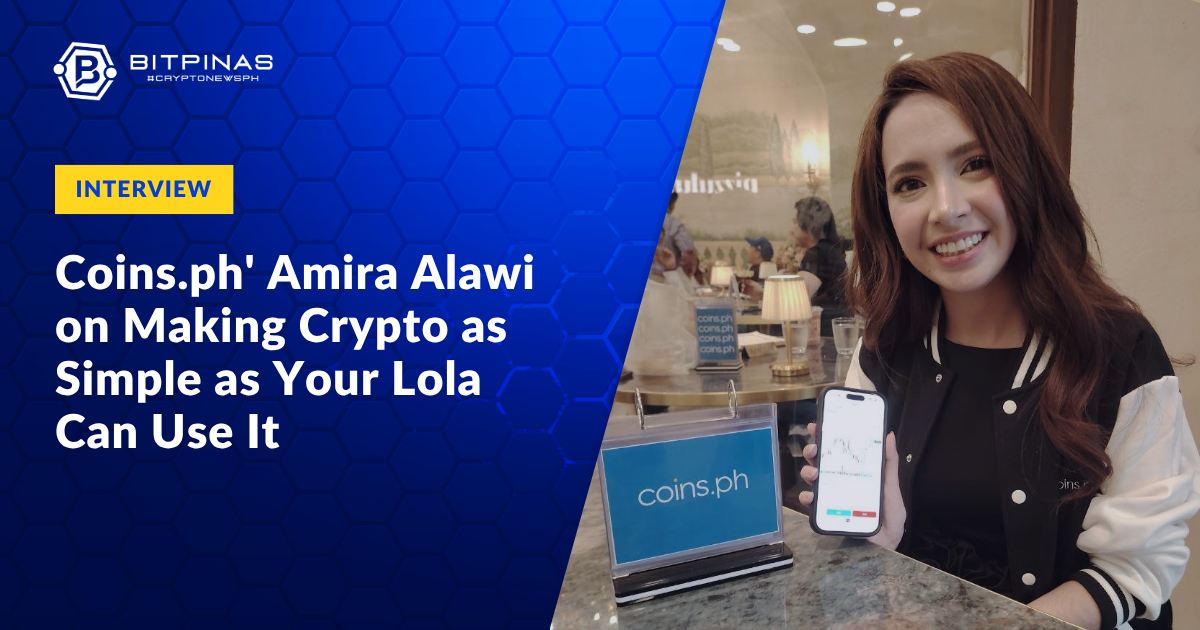
Amira Alawi, the Global Marketing Director of Coins.ph, discussed the platform’s plans regarding stablecoin utility and local crypto adoption. The interview took place during the Coins.ph Merchant Crawl in Bonifacio Global City (BGC), an experiential event showcasing the Philippines’ stablecoin-to-QRPh integration by allowing participants to buy lunch, coffee, and dessert using USDT and USDC. (Initial coverage here.)
The Context: As the Bangko Sentral ng Pilipinas (BSP) continues to crack down on unlicensed offshore exchanges, domestic platforms are rushing to prove crypto’s real-world value.
In this interview with multiple reporters, edited for clarity, Alawi addresses how Coins.ph is driving stablecoin utility to fix the country’s expensive OFW remittance market, navigating strict local regulations, and transitioning Filipinos away from speculative trading toward severyday digital payments via nationwide QRPh integrations.
Interview Transcript: Amira Alawi (Coins.ph)
Good afternoon, Today, Coins.ph is highlighting the real-world utility of stablecoins like USDT for everyday transactions, such as buying food and retail shopping. Could you explain why Coins.ph is choosing to showcase stablecoins specifically? What sets this particular class of crypto assets apart?
Amira Alawi: We are really pushing the utility case of USDT and USDC, making it so that crypto is spendable and so simple that your lola (grandmother) can use it. That’s the biggest thing we are pushing. Unlike other cryptocurrencies that are more volatile, we initially started with USDT and USDC, though more pairings will be added.
Looking at the broader picture of crypto adoption in the Philippines, how much market share or user traction has Coins.ph successfully captured so far?
Amira Alawi: There’s a lot of people using Coins, but we don’t want to limit it to just the Philippines. There are a lot of OFWs outside the Philippines, and this is the biggest market we’re wanting to tap because traditional remittance costs a lot of money. I grew up in the Middle East, so I know that sending money home with a 3% to 5% fee is a big deal. We want to make sending money faster so you don’t have to queue in line, and also ensure the spendability of the receiver. Instead of going to the bayan (town) or to physical counters to get the money, everything is on your phone. You’re able to trade and spend. If you want to keep it in USDT, you can; if you want to keep it in PHP, you can convert it, but you can already spend it as is.
For the average Filipino who might be hesitant or entirely unfamiliar with digital currencies, how can you assure them that spending assets like USDT is both safe and practical?
Amira Alawi: A big part of it is the education piece, showing them that it is spendable. Also, Coins itself is regulated by the BSP. People think that crypto is strictly a volatile asset, but in actuality, more and more governments are using crypto. I think Asia, especially for the underbanked, can quickly adopt this and just make life easier.
Given those barriers, do you genuinely believe the Philippine market is ready for mass adoption?
Amira Alawi: Primarily, it’s the Gen Zs who are really big on going digital and embracing this kind of technology. But again, we don’t want to limit it to any age group, and we’re seeing a lot of interest. Even the government is trying to look into crypto and blockchain; they want to be among the first in Asia to really embrace this technology. With AI causing redundancy and a lot of people being laid off, cryptocurrency is opening a new vertical and a new opportunity, not just in terms of the sector, but also in terms of money movement.
Coins.ph seems to be expanding its reach significantly. How many merchant and payment partners do you currently have onboarded locally to facilitate these transactions?
Amira Alawi: For now, it’s QRPh. Anywhere that there’s QRPh, we’re affiliated with those. But we’re also working with traditional B2Bs and remittance groups themselves as the infrastructure layer behind the scenes so that money movement becomes cheaper, faster, and works on weekends and holidays.
From a user experience standpoint, is it necessary for a Coins.ph customer to manually convert their Philippine Peso into USDT or USDC before executing a merchant payment?
Amira Alawi: It’s not necessary because you can pay in PHP already, just like an ordinary e-wallet. But for those who want to receive in USDT and USDC, it will be received in USDT so that it’s easier to move money from international countries, and you can already spend it as is. That’s one of the reasons we’re pushing for crypto utility. If they want to convert it, they can; if they want to keep it as is, they can also. The US dollar is much stronger than a lot of the currencies in Asia, so that is another element to it.
Can users rely on their Coins.ph wallets for transactions when traveling abroad, or are there regulatory limitations outside the country?
Amira Alawi: Because of regulatory factors, you can use it to trade, but we are pushing for the QRPh to be borderless. For now, we’re starting in the Philippines with QRPh, not yet QR in other countries.
You mentioned international remittance channels earlier. How exactly does that cross-border mechanism work?
Amira Alawi: We work with remittances, but international remittances are a completely different setup. As for the countries we’re active in, we are active in Thailand, Brazil, Mauritius, and we are about to launch in Hong Kong, but it’s a different setup there. We want to make it like the Philippines, where you can trade different assets but also spend it smoothly.
While this works seamlessly in Metro Manila, what is the experience like in rural areas or provinces? Are you ensuring that Coins.ph remains highly functional outside the major cities?
Amira Alawi: Yes, truly anywhere, for dining, travel, or shopping. Anywhere that there’s QRPh, you can use it, and we’re also working towards the card side. There are some parts of the Philippines where the internet is not the strongest, so we are working on the government and regulatory side of things.
Moving on to regulation, the Bangko Sentral ng Pilipinas recently issued a new public advisory cautioning consumers against unauthorized Virtual Asset Service Providers (VASPs). What are your thoughts on this, and how does it impact compliance for local platforms?
Amira Alawi: Yeah, I am aware ’cause I was previously with MEXC, and, like, this is a challenge. One of the reasons the government is pushing the regulatory side is because crypto is still a new technology and they don’t fully know what it is yet. If you’re a millennial, you might remember when the internet first came out and people were hesitant because of the dot-com bubble. The same thing happens with any new technology being introduced, and right now we are in that phase for crypto.
In your opinion, what proactive steps should the Philippines take as a country to responsibly onboard more citizens into the digital asset space?
Amira Alawi: A lot of crypto people would say, “Onboard them, convince them.” But it’s less about convincing and more about showing that it’s usable money. I’m really pushing for the utility case. If it’s faster, if it exists, and you start using it in your daily life, it’s easier to see what works for you versus trying to convince people to come on board. The biggest factor is usability, exposure, and having conversations “in the trenches”.
Right now, crypto is still happening behind closed doors at exclusive events, and some people aren’t comfortable attending those. They think, “Ay, hindi ako crypto native” or “Hindi ako techie.” My mom was like that when she first heard about crypto. But if I send my mom money to buy groceries and she uses the stablecoin side, it becomes easy to understand. Once you’re actually using it, it gets embedded in your daily life.
When comparing blue-chip cryptocurrencies like Bitcoin to fiat-pegged stablecoins, do you believe stablecoins offer a structurally better entry point for the mainstream public?
Amira Alawi: Stablecoins are stable, so people who are afraid of volatility can use them as their first entryway. With traditional crypto, there are market cycles, bear cycles and bull cycles. One of the biggest challenges for Filipinos is entering the market the wrong way, like what happened with Ronin. There were people who mortgaged (nagsanla) their houses and went all-in on a certain crypto thinking it was going “to the moon.” They entered crypto strictly as a speculative asset, thinking it would just keep going up. They weren’t aware of fundamental or technical analysis, or the factors that affect price movement. Then their money is suddenly 60% down. After experiencing that kind of trauma and PTSD, will they ever touch crypto again?
With stablecoins, it’s less about jumping in due to FOMO; it’s more about the actual use case. If you want to assign a small aspect of your portfolio to trading, you can slowly learn about it with small amounts rather than listening to the internet hype about “100x” gains. Exposing people a little bit at a time starts with stablecoins because they are the easiest entry point. They are pegged to the US dollar, they don’t fluctuate wildly, and they are cheap to move and use.
Listen to our latest episode
To wrap things up, what practical advice would you give to Filipinos who want to navigate stablecoin trading, grow their crypto savings, or simply explore digital wallets without getting overwhelmed?
Amira Alawi: Ask questions and find a community, because that’s the biggest thing. A lot of us learn through trial and error. If you want to learn to trade, find people who are doing what you want to do and be in those rooms. Don’t be afraid to be a beginner. If you don’t know something, ask. Tools like ChatGPT exist, but having real human conversations is what matters most. When you are in those spaces, it’s completely okay to say, “Beginner ako.” Sometimes people enter a room and feel too shy or intimidated because everyone else seems like a big trader showing screenshots of massive portfolio gains. It creates an intimidation factor where people think, “I’m not good at math, I can’t be at that level.” We need to make it less intimidating, more welcoming, and easier for new users to get in.
This interview is published on BitPinas: Interview: Coins.ph’ Amira Alawi on Making Crypto as Simple as Your Lola Can Use It
What else is happening in Crypto Philippines and beyond?