Key Takeaways
- Coinbase validators held 4.5M ETH staked at 99.98% uptime in Q1 2026, outperforming the network average.
- Coinbase operates across 5 countries and 2 cloud providers, reducing single-point failure risk for ETF issuers and institutions.
- With a 3rd consensus client onboarding, Coinbase aims to further diversify validator infrastructure through 2026.
Coinbase Holds 12% of Staked ETH With Self-Imposed 30% Network Cap in Q1 2026
According to the report, the exchange averaged 4.5 million ETH staked to its validators during the quarter, representing 12.17% of total staked Ethereum on the network. Coinbase has set a self-imposed ceiling of 30% network penetration, a threshold it says it will not cross.
Uptime came in at 99.98% for the quarter, above the network average of 99.77%. The company recorded zero slashing or double-signing events since it first launched validator operations.
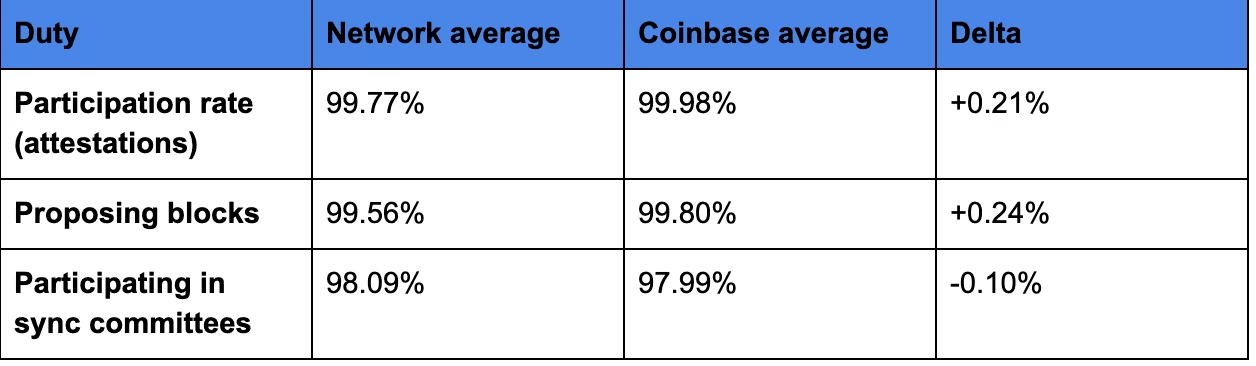
Participation rate, which Coinbase treats as interchangeable with uptime, measures how consistently validators sign, submit, and get their attestations included in blocks. The company says its validators outperformed the network average across two of three key duties tracked: block proposals and sync committee participation.
Coinbase distributes its validators across data centers in Germany, Hong Kong, Ireland, Japan, and Singapore. Each region operates with multiple availability zones. The company runs workloads on both AWS and GCP to reduce exposure to a single cloud provider and to contain the impact of any regional outage.
The company says a validator orchestration system exists to migrate validators between data centers if a prolonged cloud or regional failure occurs. That system has not been triggered by an outage but has been used during routine validator migrations and scheduled maintenance.
On the client side, Coinbase supports two consensus clients, Lighthouse and Prysm, with a third currently being onboarded. Execution clients include Geth, Nethermind, and Reth. Running multiple clients reduces the risk that a bug or outage in any single client affects the full validator set.
Seven MEV relays are connected to the validator infrastructure: Flashbots Relay, bloXroute Max Profit Relay, bloXroute Regulated Relay, Ultra Sound Relay, Agnostic Relay, Aestus Relay, and Titan Relay. Using multiple relays, Coinbase says, improves redundancy and increases the likelihood that block proposers receive competitive bids, which affects priority fees and MEV rewards.
A Commitment to Transparency at an Institutional Scale
OFAC screening is available as an option for customers who need transaction filtering, which Coinbase says further expands relay diversity for that subset of users. The report positions these infrastructure decisions as central to Coinbase’s pitch to institutional clients and ETF issuers. The company says institutions evaluating staking programs weigh trust, resilience, and long-term alignment as much as yield.
Coinbase says it outperformed its institutional peer set on Ethereum APY during Q1, framing strong returns and responsible operations as complementary rather than in tension.
The exchange states plainly what it will not pursue: strategies that concentrate risk, compromise network integrity, or favor short-term gains. It frames the validator report itself as part of a commitment to transparency at an institutional scale.
For large-scale staking programs, the report signals where Coinbase sees its competitive position heading: fewer tradeoffs between performance and operational discipline, and more accountability built into every layer of the infrastructure stack.

Bitcoiner Dumps Old Computer Files Into Claude AI, Recovers 5 BTC Lost Since 2015
A bitcoin holder known on X as @cprkrn recovered approximately 5 BTC, valued between $400,000 and $500,000, from a wallet…


Bitcoiner Dumps Old Computer Files Into Claude AI, Recovers 5 BTC Lost Since 2015
A bitcoin holder known on X as @cprkrn recovered approximately 5 BTC, valued between $400,000 and $500,000, from a wallet…
Bitcoiner Dumps Old Computer Files Into Claude AI, Recovers 5 BTC Lost Since 2015
A bitcoin holder known on X as @cprkrn recovered approximately 5 BTC, valued between $400,000 and $500,000, from a wallet…